Build It Yourself: 21 DIY Plant Stands That Transform Your Indoor Plant Display
Disclosure : This post may contain affiliate links or paid partnerships. I may earn compensation if you click a link or make a purchase, at no additional cost to you. See my disclosure for more info.
You bought the plants.
The gorgeous fiddle leaf. The cascading pothos. That adorable little succulent set from the weekend market.
You were genuinely excited.
You watched all the videos. You saved all those stunning home tours showing flawlessly styled green corners straight out of an interior design spread.
Then reality set in.
Your plants ended up on the floor. Lined up against the baseboard like they’re waiting for something to happen.
Or they’re jammed on the windowsill. Competing for space with a half-burned candle, an old mug, and a pile of unopened mail.
Maybe you balanced one on a stack of books. It looked okay for a few days. Until you watered it and the water seeped down and wrecked the spines.
Fantastic.
You thought about picking up a proper plant stand. Something that looked intentional. Something stylish.
Then you looked at the prices.
Fifty. Seventy. Ninety dollars for a stand.
For a plank of wood with four legs attached.
You closed the tab. Walked away.
Your plants stayed on the floor.
Your room stayed… acceptable.
Not vibrant. Not welcoming. Not “wow.” Just acceptable.
But here’s what you need to hear.
It doesn’t have to be this way.
You don’t need a decorator’s checkbook. You don’t need a garage full of expensive equipment. You don’t even need to consider yourself “crafty.”
What you need is one solid idea and a free afternoon.
That’s exactly what you’ll find here.
Twenty-one DIY plant stand ideas that actually look great. That are genuinely buildable. That will shift the entire energy of your space the moment you set them down.
Some take half an hour. Some take a full hour. Not one of them requires a degree in engineering.
Ready to get started?
Let’s do this.
1. The Secondhand Stool Revival
Step into any thrift store near you.
Hunt for a compact wooden stool. The older and quirkier, the more potential it has.
Give it a light sanding. Roll on a fresh coat of paint — chalky white, dusty sage, warm terracotta, whatever feels right to you.
Sit your plant on top.
Done.
You just created a plant stand with more character than anything at a chain furniture store. Probably for about four bucks.
The secret? Don’t obsess over perfection. The small imperfections are exactly what give it life.
2. The Copper Pipe Three-Legged Stand
This one looks like it came with a significant price tag.
Spoiler: it didn’t.
Three short copper pipes. Three elbow fittings. One circular wooden top.
Join the pipes into a tripod. Affix the disc on top. Finished in under twenty minutes.
The rich copper tones alongside lush green foliage is one of those pairings that simply never fails. It’s effortless, elegant, and looks intentional every single time.
3. The Mid-Century Hairpin Leg Pedestal
Hairpin legs are surprisingly affordable online.
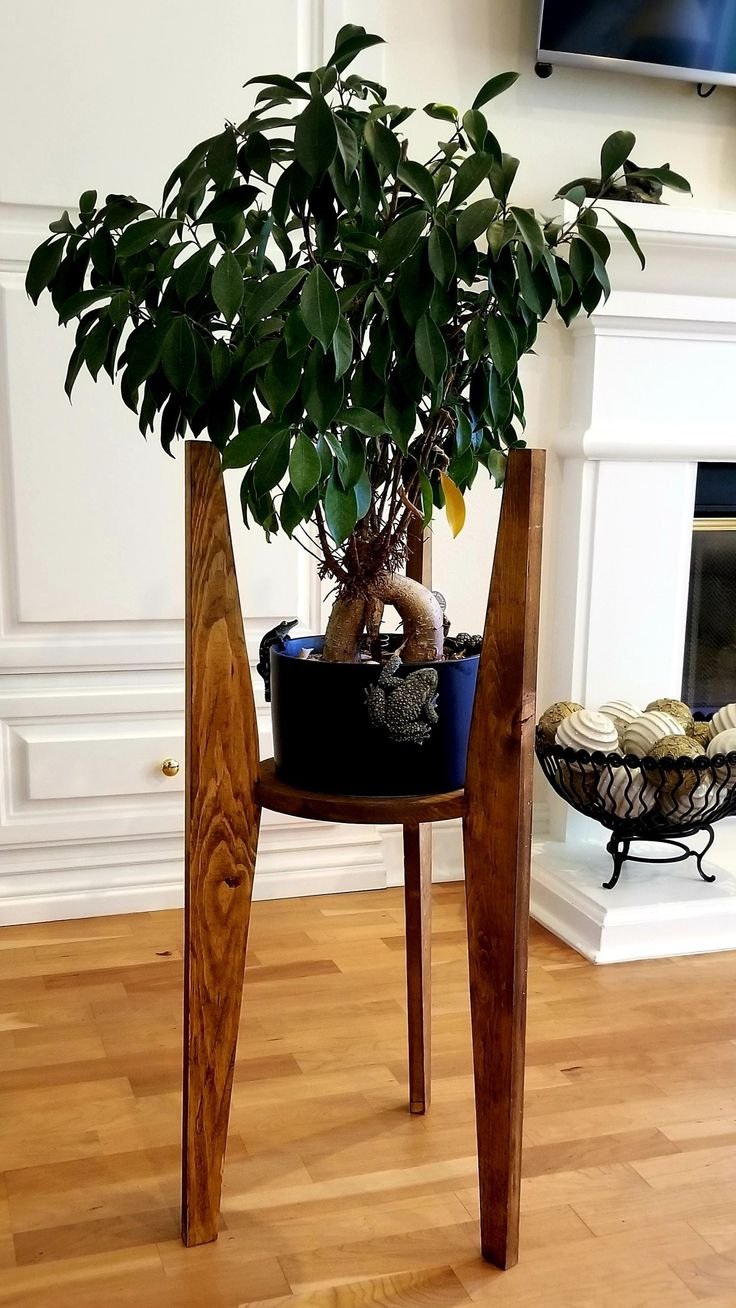
Order a set of four. Drive them into a round wood plank. And just like that, you’ve got a mid-century style plant stand that could easily sell for sixty dollars at a boutique home store.
You assembled it for under fifteen.
Want to push it further? Stain the wood a deep walnut shade. The way the dark grain plays against the bright metal legs is genuinely stunning.
4. The Vertical Stacked Crate Tower
Collect two or three wooden produce crates.
Stack them upright. Rotate the openings to face alternating directions.
Each crate becomes its own dedicated plant pocket. The result is a multi-level display that adds height, texture, and visual interest to any dull corner.
Paint them a single matching color for a polished finish. Or leave them raw and weathered for that rustic farmhouse appeal. Both directions work beautifully.
5. The Knotted Cotton Plant Hanger
Macramé never really went away. And with good reason.
A simple knotted plant holder takes about an hour and a spool of cotton rope.
There are hundreds of video tutorials available. Find one that clicks with your learning style and follow along.
The result is a suspended plant display that reclaims floor space and adds a warm, relaxed texture to any room without looking overdone.
An ideal choice for compact apartments where every inch of floor space is valuable real estate.
6. The Painted Concrete Block Riser
This one sounds deceptively simple. Stick with me for a moment.
Pick up a single cinder block. Paint it flat black. Rest your plant on the flat top surface.
Project complete.
But the visual tension it creates — rough, industrial concrete underneath a soft, living plant — is precisely the kind of deliberate contrast that interior stylists reach for on purpose.
And you pulled it off for roughly two dollars.
7. The Wall-Leaning Ladder Shelf
An aged wooden ladder propped against a wall instantly becomes a vertical plant showcase.
Each rung supports a different sized pot. You gain variation in height, a natural visual rhythm, and not a single square foot of floor space sacrificed.
No old ladder in the shed? Build one from scratch. Two long boards, a handful of wooden dowels, some screws, and about an hour of work.
Stunning beside a sofa, brilliant in a hallway that has nothing interesting happening.
8. The Inverted Garden Cage Stand
Take a standard wire tomato cage and flip it upside down.
Give it a coat of spray paint — gold, matte black, or copper all look sharp.
Balance a pot on the flat upper ring.
The wire frame below creates an open, almost sculptural silhouette that reads as intentional and clever. Visitors will absolutely notice it.
And the whole thing costs you next to nothing.
9. The Twine-Wrapped Tin Planter
You already have tin cans in your recycling bin.
Pull one out. Begin wrapping thick natural jute cord from the base to the lip, securing each row with a dab of hot glue.
In about fifteen minutes, something destined for the bin becomes a warm, textured boho planter that looks entirely purposeful.
Make a set of three in different heights. Display them as a cluster. Watch every guest assume you ordered them from an artisan shop.
10. The Single Wall Shelf Plant Spotlight
One wall-mounted shelf. Hung at eye level. One exceptional plant placed front and center.
Nothing else on it.
That’s not deprivation — that’s making a bold statement.
The wall becomes the backdrop. The plant becomes the focal point. This approach works exceptionally well in bathrooms where surface space is limited, or in kitchens where you want greenery without adding clutter.
11. The Natural Wood Slice Base
Track down a thick cross-section cut from a real tree trunk and you’ve found something special.
Smooth the top face with sandpaper. Keep the rough bark along the perimeter. Finish with a clear protective sealant.
No two pieces are ever identical. The grain lines, the tones, the organic shape — each one is a one-of-a-kind object.
A plant resting on top connects your interior space to the natural world in a way no manufactured stand can replicate.
12. The Modular Pegboard Plant Gallery
Hang a pegboard panel on your wall. Attach hooks and mini shelves exactly where you want them.
The real beauty of this system is complete flexibility.
Rearrange everything whenever the mood strikes. Add another plant next season. Overhaul the layout entirely in ten minutes with zero tools.
It’s a display system that evolves with your collection. Literally and figuratively.
13. The Repurposed Chair Planter
That wobbly old chair gathering dust in storage?
Stop trying to repair it.
Pull out the seat panel. Drop a pot into the empty opening. Let a trailing vine spill down over the legs.
It becomes an instant conversation starter that looks like it belongs in a thoughtfully styled boutique.
This is repurposing at its most satisfying. You didn’t just rescue something from the landfill — you transformed a problem into the most memorable object in the room.
14. The PVC Pipe Height Cluster
Cut PVC pipes into three or five sections of varying heights.
Glue round wooden discs onto each pipe top. Spray everything a single unified color.
Arrange them in a tight cluster.
What you’re looking at is a contemporary sculptural plant grouping that could hang in a design gallery.
The essential detail: vary the heights deliberately. Short, tall, medium, very tall, short again. That rhythm is what separates a polished arrangement from a random pile of pipes.
15. The Bent Wire Geometric Cradle
Source some heavy-gauge wire. Shape it into a geometric form — a cube, a hexagon, a triangle frame.
Nestle your pot inside.
The open negative space surrounding the plant makes it visually stand out. The geometric structure acts like a frame directing your attention to the greenery inside.
It takes patience and a sturdy pair of pliers. But the result looks like a forty-dollar find from a handmade goods marketplace.
16. The Window Ledge Plant Line
Fix a slim shelf directly across the inside of your window frame.
Fill it edge to edge with small pots.
Your plants receive maximum daylight exposure. Your window transforms into a living installation. And you haven’t given up a single inch of floor space or counter space.
Herbs are perfect here. You gain décor and a fresh cooking supply simultaneously. That’s what a genuine double win looks like.
17. The Mobile Rolling Plant Cart
Those compact wheeled multi-tier carts?
They weren’t designed just for kitchen storage.
Stack it with your plants. Wheel it toward the brightest window each morning. Roll it back when the light shifts in the evening.
A portable garden that chases the sun.
Practical, charming, and a genuine solution to that persistent problem of “this plant needs more light but there’s nowhere near the window to put it.”
18. The Wall-Mounted Box Frame Display
Construct a simple open-fronted wooden box. Secure it to the wall.
Tuck a potted succulent or air plant inside the opening.
The framing creates a shadow box effect — it directs the eye straight to the plant like a spotlight. Like a framed photograph, but alive.
Mount three in a horizontal row with even spacing between them. That stops being a DIY project and becomes an installation piece.
19. The Layered Basket and Stool Vignette
Select a woven seagrass basket. Place your pot inside it. Set the whole basket on top of a short wooden stool.
Three distinct levels: stool, basket, plant.
This layered composition creates depth and visual complexity that a pot sitting alone on the ground simply cannot achieve.
It reads as curated. Considered. Like you actually spent time thinking about it.
Because you did.
20. The Hanging Wire Basket Plant Tower
Those hanging tiered wire baskets typically used for produce?
Fill each tier with a small plant instead.
Hang near a sunny window. Each basket holds a different plant variety. You’ve just built a vertical garden using precisely zero floor space, counter space, and shelf space.
It uses ceiling space. Which was sitting idle anyway.
21. The Curated Book Stack Platform
Yes, books as a plant riser. But this time, do it with purpose.
Choose hardcovers with coordinating spine tones. Stack them squarely and deliberately. Slide a saucer underneath the pot to guard against water damage.
This works beautifully in a study or reading corner. It blends two passions — plants and literature — into a single intentional display.
The line between “sloppy” and “chic” here comes down entirely to intention. When it reads as accidental, it looks like clutter. When it reads as deliberate, it looks designed.
The Single Rule That Makes Every Stand Look High-End
You could build the most inventive plant stand imaginable.
And still have it look completely off.
How is that even possible?
Wrong proportions.
A tiny succulent on a hulking pedestal looks forgotten. Like a child swallowed up in an oversized coat.
A sprawling monstera balanced on a flimsy little table looks like an accident in slow motion.
Match the visual weight of your plant to the visual weight of your stand. Large, full plant — solid, substantial base. Small, delicate plant — light, minimal stand.
This single principle separates “cute attempt” from “hold on — did you make that?”
The Habit That Keeps Your Space Looking Half-Finished
You made it through every idea on this list.
Some of them grabbed you right away. Others didn’t. That’s exactly how it should work.
But here’s the pitfall to avoid.
You save everything and build nothing.
You bookmark this page. You screenshot a few ideas. You tell yourself you’ll tackle it “when things slow down.” Or “after you move.” Or “once the living room repaint is finished.”
And in six months, your plants are still on the floor.
Still looking like an afterthought.
Still making your room feel like it’s waiting to become something.
Don’t let that happen.
Start Here, Start Now
Choose a single idea from this list.
Just the one that felt most doable.
The one that made you think “yeah, I could pull that off.”
Get the supplies this weekend. Set aside an hour. Build it.
Place your plant on it.
Step back.
Your room will feel genuinely different. Not because of money spent. Not because of a professional’s involvement. But because you created something with your own hands and placed it with real intention.
That’s the gap between a space that feels like a waiting area and one that feels unmistakably like yours.
Your plants have waited long enough.
Your room has waited long enough.
Time’s up.
Go make it happen.