28 Japanese Bathroom Concepts That Will Transform the Way You Unwind
Disclosure : This post may contain affiliate links or paid partnerships. I may earn compensation if you click a link or make a purchase, at no additional cost to you. See my disclosure for more info.
You drag yourself home, completely drained.
Your muscles ache. Your thoughts won’t quiet down. Your notifications keep piling up.
So you walk into your bathroom, glance around, and feel… nothing at all.
No peace. No sense of relief. Just a cold, cluttered space with mismatched accessories and fixtures you keep promising yourself you’ll update.
Sound about right?
Here’s what most people miss. Your bathroom could be the single room in your home that genuinely restores you. The space that brings everything to a standstill the moment you enter it.
That’s not wishful thinking. That’s precisely what Japanese bathroom philosophy is designed to achieve.
Not for appearances. Not for social media. For you.
And you don’t need to demolish your home, travel abroad, or drain your savings to get there.
You just need the right direction. And the right mindset.
So let’s dig in.
Why Japanese Bathrooms Hit Differently
Before we go through the ideas, let’s talk about the core difference.
In Japan, the bathroom isn’t simply a utility space. It’s a ceremony.
Bathing is about clearing the mind as much as cleansing the body. That philosophy drives every design decision — from materials to layout to how light behaves in the room.
The outcome? A space that functions like a refuge.
And the great news? Most of these principles are remarkably straightforward to put into practice, regardless of your budget or square footage.
Now let’s walk through the ideas that can genuinely change your space.
Spatial Flow & Layout
1. Divide the wet and dry zones
Traditional Japanese homes keep the bathing area and the changing area completely separate. The logic is elegant: water stays where it belongs.
Even in a compact bathroom, a glass partition or a small step-down can create that division. It keeps the floor drier, the space cleaner, and the energy calmer.
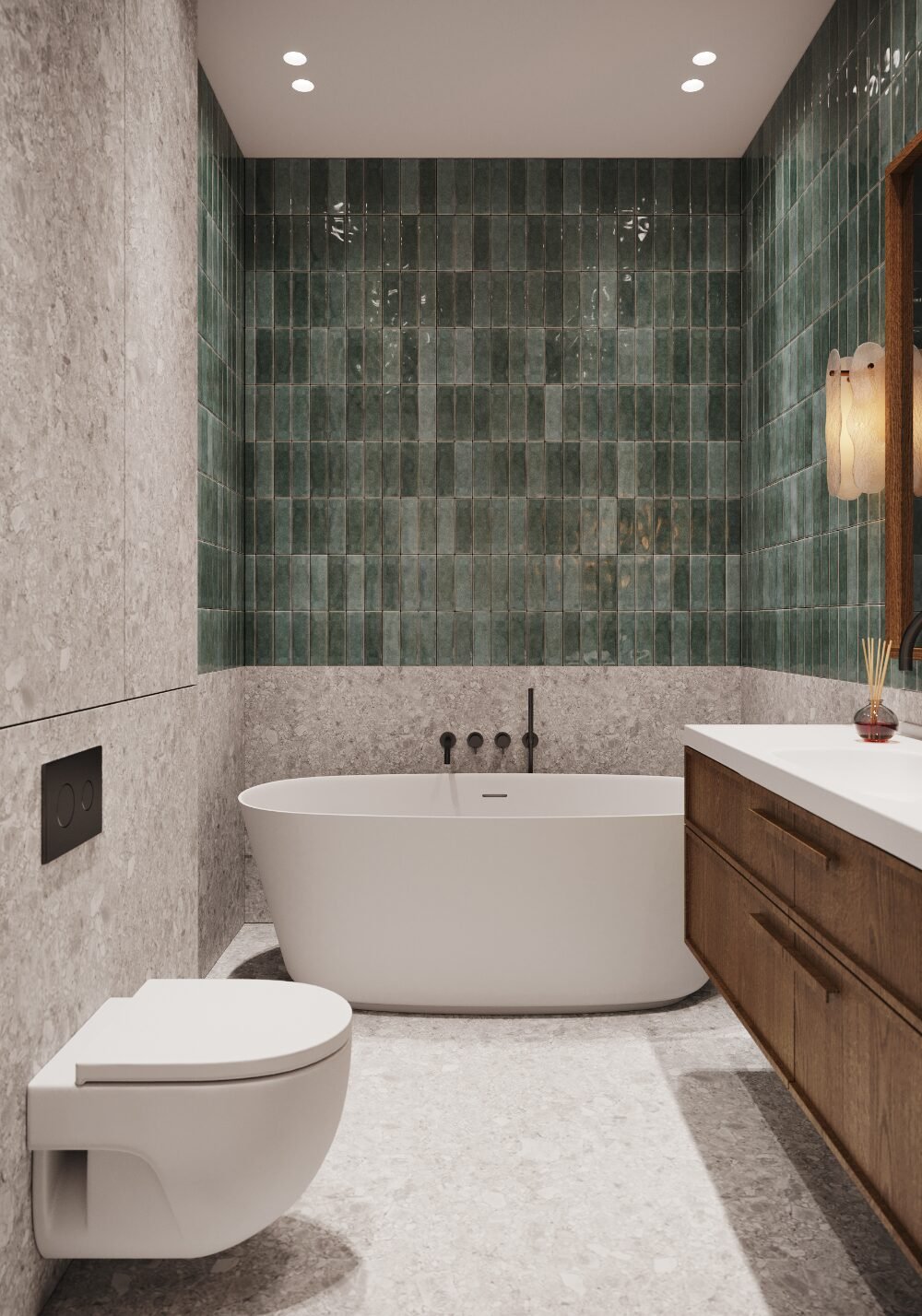
2. Make the soaking tub the focal point
Stop treating the tub like an afterthought pushed into a corner. In Japanese design, the tub anchors the room.
It’s the central feature. Everything else orbits it.
If you have the space, position your soaking tub so it’s the first thing you notice when you enter.
3. Build a separate pre-soak shower station
This is one of the sharpest contrasts with Western bathroom culture. You cleanse yourself before you bathe.
A low-level shower station with a handheld showerhead and a small wooden stool lets you rinse fully before entering the tub.
The water stays clean. The ritual stays intact.
4. Give the toilet its own separate enclosure
This isn’t a question of having a large bathroom. A simple pocket door or partition does the trick.
Japanese design treats the toilet as its own distinct function. Separating it makes the bathing area feel more like a sanctuary and less like a utility closet.
Materials That Create Atmosphere
5. Incorporate hinoki cypress wood elements
Hinoki is the benchmark material for Japanese bathroom woodwork. It resists moisture and mildew naturally.
But its greatest quality is the fragrance. Hinoki releases a warm, citrus-tinged scent when heat and steam hit it.
A hinoki bath mat, a stool, or a small tray beside the tub can shift the entire mood of the room.
6. Ground the space with natural stone
River stones, slate, or pebble tiles on the floor establish a physical connection to the natural world.
Walking barefoot on a pebbled shower floor isn’t just visually appealing. It provides a gentle foot massage every time you shower.
7. Opt for matte over glossy surfaces
Polished tiles feel like a hotel lobby, not a home retreat.
Matte finishes — on tiles, fixtures, and surfaces — absorb light gently. They make a room feel warmer and more settled, which is at the heart of the Japanese aesthetic.
8. Add washi-inspired textured wall surfaces
You don’t need actual washi paper in a damp environment. But wall panels that echo that soft, fibrous texture bring a quiet layer of warmth to any bathroom.
It’s understated. And that restraint is entirely the point.
The Experience of Water
9. Install a deep ofuro soaking tub
If you want the authentic Japanese bathroom experience, this is non-negotiable.
An ofuro is deeper and more compact than a standard Western tub. You sit upright, submerged to your shoulders, fully enveloped by the water.
Freestanding options in acrylic or wood are available at every price point. This single upgrade has the power to transform how bathing feels entirely. A deep soaking tub is the heart of the Japanese bathing tradition.
10. Mount a rain showerhead directly above
A rain showerhead recreates the sensation of standing beneath a gentle downpour.
No lateral spray. No jet pressure. Just water falling straight down and covering you completely.
It’s the difference between a functional rinse and a meditative pause.
11. Add a handheld wand on an adjustable rail
Adaptability matters. A sliding rail lets you set the right height whether you’re standing or seated on a bathing stool.
It’s a practical tool, but it also reinforces that Japanese ethos of purposeful cleansing.
12. Introduce a small water feature for ambient sound
The sound of flowing water is deeply woven into Japanese culture — think of the bamboo shishi-odoshi in traditional gardens.
A tabletop fountain beside the tub, or a wall-mounted spout that trickles quietly, adds a layer of sonic calm that no candle can replicate.
Lighting That Soothes Rather Than Startles
13. Install warm, dimmable bulbs
Bright overhead fluorescents are the fastest way to kill any sense of tranquility.
Replace them with warm LED strips tucked behind mirrors or beneath floating vanities. Add a dimmer. Take control of the atmosphere the same way you control water temperature.
14. Use a backlit mirror for diffused glow
A backlit mirror does more than look polished. It removes the sharp, unflattering contrast of standard vanity lighting.
It casts a soft luminous halo that makes the entire room feel gentler.
15. Introduce lantern-style fixtures or candle warmth
Japanese paper lantern-inspired pendants or simple candle holders placed along the tub ledge bring in flickering warmth.
There’s a reason every spa on the planet uses candlelight. It tells your nervous system it’s safe to let go.
Minimalism That Actually Works
16. Tuck everything behind closed doors
Visual clutter destroys any sense of peace.
Floating vanities with soft-close drawers, recessed medicine cabinets, and built-in shower niches ensure your products are out of sight when not in use.
A Japanese bathroom looks immaculate because it is immaculate. Visually, at least.
17. Keep your color palette tight
Whites. Warm greys. Soft earth tones. Natural wood grain.
That’s the full spectrum. No accent walls in bold colors. No decorative shower curtains with patterns.
Restraint is exactly what generates that sense of expansive calm, even in small spaces.
18. Select one hero piece and give it room to breathe
A single sculptural vase. A beautifully formed soap dish. One elegant orchid.
Japanese design is rooted in the concept of “ma” — the power of negative space. What you choose not to include is as important as what you do.
19. Commit to matching towels in one neutral tone
Mismatched towels can undermine even the most carefully designed bathroom.
Choose one color. One fabric weight. Fold them neatly or roll them on an open wooden shelf. It’s a small shift with a disproportionate impact.
Inviting Nature Into the Space
20. Add a humidity-loving living plant
Ferns, pothos, bamboo, or peace lilies thrive in bathroom conditions.
A single green plant on a wooden shelf near the tub creates an effortless bond with nature. The Japanese call this concept “shizen” — beauty that arises naturally, without force.
21. Rest a bamboo tray across the tub
A bamboo tray spanning your soaking tub holds a cup of green tea, a book, or a single candle.
It’s not about accumulating accessories. It’s about creating a reason to pause. A ritual. Permission to stay just a little longer.
22. Frame a view wherever you can find one
If you have a window in the bathroom, resist covering it with heavy fabric. Use frosted glass for privacy and let the daylight work.
No window? Hang a simple nature print or a photograph of a landscape your gaze can settle on.
Your eyes need somewhere quiet to land.
Sensory Layers That Complete the Ritual
23. Get a heated towel rack
Stepping out of a deep soak and wrapping yourself in a warm towel is one of life’s truly underrated pleasures.
A wall-mounted heated towel rack is affordable, simple to install, and makes every single bath feel like a luxury hotel moment.
24. Try cedar or eucalyptus shower bundles
Tie a fresh bundle of eucalyptus to your showerhead. Steam activates the essential oils and floods the room with a clean, natural fragrance.
No diffuser required. No plug-in freshener. Just plants doing what plants do.
25. Warm your floor
Cold tiles against bare feet first thing in the morning is jarring. It destroys any sense of calm before it even begins.
Radiant floor heating is the gold standard. But even a well-chosen wooden bath mat in the right spot does the job beautifully.
26. Be deliberate about ambient sound
A small waterproof Bluetooth speaker playing rainfall sounds, shakuhachi music, or soft ambient noise transforms what you hear as well as what you see.
Sound is the most neglected dimension of bathroom design. That’s a mistake worth correcting.
27. Pick one refined, consistent scent
Not a heavy perfume. Not something that overwhelms the room.
A hinoki wood chip resting in a small ceramic bowl. A single incense stick before your bath. A drop of cedarwood oil dissolved in warm water.
The Japanese practice of “kodo” — the path of fragrance — treats scent as a route to mindful presence, not decoration.
28. Hang a cotton yukata or robe on the door
The experience doesn’t end when you step out of the water.
A lightweight robe — cotton or linen — draped on a simple wooden hook carries the ritual forward. You move from warm water to warm fabric without ever breaking the spell.
That transition is more meaningful than it seems.
Why Any of This Actually Matters
This isn’t really about redecorating.
It’s about building a space that gives something back to you. Each and every day.
A room where the noise stops. Where no one is asking anything of you for twenty minutes. Where your body finally releases the tension it’s been holding all day.
Japan has understood this for centuries. Bathing isn’t maintenance. It’s restoration.
And you deserve a bathroom that treats it that way.
You don’t need to implement all 28 ideas. Start with one. Maybe it’s the soaking tub. Maybe it’s just clearing the clutter and adding a plant.
Whatever you choose, choose it with intention.
Because that’s the real foundation of Japanese bathroom design. It’s not the materials or the lighting or the layout.
It’s the belief that your daily moments of stillness are worth designing for.
And then building a room that makes those moments effortless.
Now go create it.