How to Style a Futon in the Living Room Like an Interior Architect Would
Disclosure : This post may contain affiliate links or paid partnerships. I may earn compensation if you click a link or make a purchase, at no additional cost to you. See my disclosure for more info.
You bought a futon.
Maybe it was a budget decision. Maybe your apartment is small. Maybe you just needed something fast for your new place.
And now you’re staring at it in the middle of your living room, and something feels… off.
It doesn’t look like the photos you saved on Pinterest. It doesn’t look like those sleek living rooms on Instagram. It looks like a college dorm leftover sitting in an adult’s apartment.
You’ve tried rearranging it. You’ve thrown a blanket over it. You even added a cushion or two.
Still doesn’t work.
And here’s the worst part. You start wondering if the futon itself is the problem. If you made the wrong purchase. If you need to spend hundreds more on a “real” sofa to make your living room look decent.
You don’t.
The futon is not the problem. The styling is.
Interior architects don’t have secret furniture that the rest of us can’t access. They use the same pieces. The same stores. Sometimes even the same budget constraints.
What they have is a method. A way of thinking about space, proportion, texture, and visual flow that turns any piece — including a futon — into something that looks intentional.
That’s exactly what this article is going to give you.
Not vague “make it cozy” advice. Not a list of expensive products. Real, actionable steps that will make your futon look like a deliberate design choice, not a compromise.
Let’s get into it.
1) Stop Treating Your Futon Like a Bed That Got Lost
This is the biggest mistake. And almost everyone makes it.
You place the futon against a wall, flat and wide, like a mattress waiting for someone to crash on it. It screams “temporary.”
Interior architects treat seating as architecture. Every piece of furniture defines the room’s geometry.
Pull your futon slightly away from the wall. Even four inches makes a difference. It creates a shadow line behind it, which gives it visual depth and makes it feel like a placed object, not something shoved into a corner.
If your futon has a wooden or metal frame, let it breathe. Don’t push it into a tight spot where the frame disappears. The frame is part of the design. Show it off.
2) Anchor It With a Rug That’s the Right Size
A futon floating on bare floor looks lost. A futon on a too-small rug looks even worse.
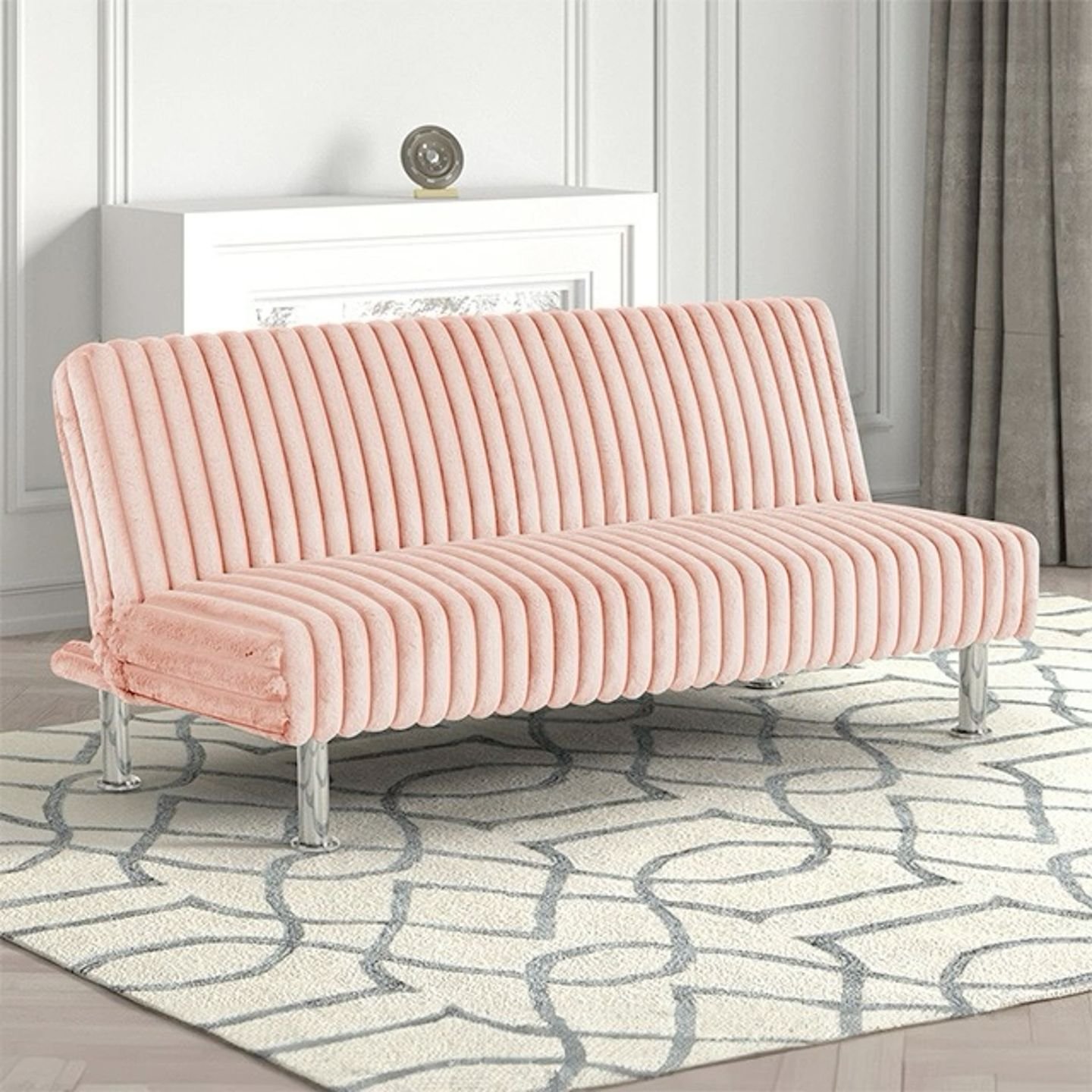
Here’s the rule interior architects follow: the rug should be large enough that at least the front legs of the futon sit on it.
Ideally, the rug extends beyond the futon on both sides and in front. This creates a visual zone — a defined seating area that tells the eye “this is a living room, not a hallway with furniture in it.”
A jute rug works if you want warmth without overwhelming. A flat-weave rug works if you want texture without bulk.
Whatever you choose, don’t skip the rug. It’s the single fastest way to make a futon setup look grounded and deliberate.
3) Use the Throw Blanket Trick That Actually Works
You’ve probably tried draping a throw over your futon.
It slid off. It bunched up. It looked messy by noon.
Here’s what works instead.
Fold the throw into a long rectangle, roughly one-third the width of the futon. Drape it over one armrest so it cascades down. Not centered. Not spread across the entire seat. Asymmetrical.
This does two things.
First, it adds a layer of texture and color without hiding the futon’s own fabric. Second, the asymmetry creates visual interest. Symmetry looks staged. Asymmetry looks lived-in and confident.
Choose a throw in a contrasting texture. If your futon is smooth cotton, go for a chunky knit or a linen throw. The contrast is what makes it look styled rather than covered up.
4) Master the Pillow Arrangement (Without Overdoing It)
Too many pillows and your futon looks like a bedding store display. Too few and it looks bare.
The sweet spot? Three to five pillows. Odd numbers always look better in design. It’s a principle architects and stylists rely on constantly.
Layer them by size. Two larger ones at the back, touching the armrests. One or two medium ones in front of those, slightly overlapping. And one smaller accent pillow off-center.
Mix textures. A velvet pillow next to a woven one. A solid color next to a subtle pattern.
But here’s the real secret: vary the shapes. Don’t use all squares. Add a lumbar pillow — rectangular — into the mix. It breaks the monotony and gives the arrangement a collected, curated feel.
5) Give It a Side Table That Means Business
A futon without a side table beside it looks incomplete.
It’s like a sentence without a period. Something feels unfinished.
You don’t need an expensive designer piece. A round side table next to a straight-lined futon creates a beautiful contrast of shapes. A wooden stool works just as well if you’re on a tight budget.
Place it at armrest height. Not taller. Not shorter. The same height as the armrest, so it feels like a natural extension of the seating area.
On top of it: a small lamp, a candle, and one book or small object. That’s it. Three items, max.
Interior architects call this a vignette. It’s a tiny composed scene that adds life to a space without cluttering it.
6) Lighting Will Make or Break the Whole Setup
You could follow every tip in this article. If the lighting is wrong, it will still look flat.
Overhead ceiling lights — the ones that came with your apartment — are the enemy of cozy, designed-looking spaces. They cast even, shadowless light that makes everything look clinical.
Add a floor lamp next to or behind the futon. A warm-toned bulb. Something in the 2700K range, which gives off that golden, inviting glow.
If you can, add a second light source on the other side of the room. A table lamp on a shelf. A string of subtle warm lights. Anything that creates layers of light.
This is exactly what interior architects do. They never rely on one light source. Multiple points of light create depth, shadow, and warmth. It makes the room feel three-dimensional instead of flat.
Your futon will look completely different under layered lighting. Completely.
7) The Wall Behind the Futon Is Not Decoration — It’s a Frame
Think of the wall behind your futon as a frame around a painting. The futon is the painting. The wall finishes the composition.
A bare wall behind it? That’s like hanging a masterpiece with no frame. It feels unfinished.
You have several options, and none of them have to cost much.
A single large piece of art, centered above the futon, with its center point at eye level when standing. Not too high. This is a mistake people make constantly — hanging art too high.
Or a gallery wall with three to five pieces of varying sizes. Keep them within the width of the futon. Don’t let them spread wider than the furniture below. That’s a rule interior architects follow religiously.
Or a large round mirror. It reflects light, makes the room feel bigger, and adds an elegant focal point above a horizontal piece of furniture.
Pick one approach. Don’t combine them all.
8) Create a Clear Traffic Path Around It
Interior architects think about flow before they think about beauty.
If you have to squeeze past your futon to get to the kitchen, no amount of styling will save the room. It will feel cramped and awkward.
Leave at least 18 inches of walking space on the main traffic side. If the room is small, angle the futon slightly rather than placing it parallel to the wall. This opens up the path and makes the room feel larger.
A futon placed thoughtfully within the room’s traffic flow looks intentional. One that blocks movement looks like you ran out of space and gave up.
9) Add a Plant — But Be Strategic About It
Plants are not just decoration. They’re vertical elements in a room full of horizontal furniture.
Your futon is low and wide. A tall plant next to it — a fiddle leaf fig, a snake plant, a dracaena — breaks up the horizontal line and draws the eye upward.
Place it on the side of the futon that feels emptiest. Usually the side without a side table, or in the corner where the futon meets the wall.
One tall plant is enough. Don’t turn the area into a greenhouse. The goal is contrast, not jungle.
If you don’t have much natural light, a quality faux plant works. No one needs to know. What matters is the visual effect — height, greenery, life.
10) Choose a Color Story and Stick to It
This is where most people go wrong without realizing it.
The futon cover is gray. The pillows are teal. The throw is mustard. The rug is red. The art is blue.
Too many colors compete with each other. The eye doesn’t know where to land. It feels chaotic.
Interior architects work with a color story — usually three colors maximum.
One dominant color (the futon cover and rug). One supporting color (the pillows and throw). One accent color (a single decorative object or piece of art).
That’s it.
When the palette is controlled, even inexpensive pieces look expensive. When it’s chaotic, even high-end pieces look like a yard sale.
11) The Coffee Table Relationship Matters More Than You Think
The distance between your futon and your coffee table is critical.
Too far, and the setup feels disconnected. Too close, and you can’t move.
Fourteen to eighteen inches between the edge of the futon seat and the edge of the table. That’s the range interior architects aim for.
A coffee table that’s roughly two-thirds the length of the futon looks balanced. Anything longer overwhelms the space. Anything shorter looks like an afterthought.
If you want to skip the traditional coffee table entirely, use two small nesting tables or a round ottoman with a tray on top. Both options are forgiving in small spaces and easy to move when you fold out the futon for sleeping.
12) Don’t Forget What Happens When It’s Unfolded
Here’s something nobody talks about in futon styling articles.
Your futon will eventually be unfolded. For guests. For movie nights. For you, if it’s your main bed.
Plan for that.
Make sure there’s enough clearance in front of the futon when it’s fully extended. Don’t place a heavy coffee table that’s impossible to move out of the way.
Keep a basket or bin nearby — something attractive — where you can toss pillows and the throw blanket when the futon converts to a bed. This avoids the pile-of-stuff-on-the-floor situation that undoes all your styling work in ten seconds.
A styled futon is only half the battle. A futon that transitions cleanly between sofa and bed mode? That’s the full win.
Your Futon Is Not the Problem. It Never Was.
Let me say this one more time.
The futon you bought is not holding your living room back. The way it’s styled is.
Every single tip in this article comes from principles that interior architects use daily — proportion, layering, color control, lighting, flow.
None of it requires demolishing your budget.
A rug, a throw, the right pillows, a lamp, one plant, and a clear plan. That’s the toolkit.
Start with the tip that jumped out at you most. Implement it today. Then come back and tackle the next one.
Your living room is about to look like you hired a professional.
You didn’t. You just learned to think like one.
Now go make that futon shine.