Stunning Plunge Pool Ideas That Will Transform Your Outdoor Space
Disclosure : This post may contain affiliate links or paid partnerships. I may earn compensation if you click a link or make a purchase, at no additional cost to you. See my disclosure for more info.
There’s a corner of your yard collecting weeds and bad intentions.
You know the one. It’s been waiting there for years, quietly judging you.
And somewhere in the back of your mind, a plunge pool keeps showing up as the answer. The cold dip after a brutal afternoon. The evening soak. The backyard you’re finally proud of.
But then the voice of reason kicks in. Cost. Mess. Complexity. And just like that, the idea evaporates.
Here’s what that voice gets wrong: a plunge pool is nothing like a full-sized swimming pool. It’s compact, purposeful, and far more achievable than most people realize.
Pick the right design and you won’t just add beauty to your property. You’ll completely change how you relate to your outdoor space.
Here are the designs worth your serious attention — along with the pitfalls you absolutely want to avoid.
How a Plunge Pool Differs From a Standard Swimming Pool
Let’s set the record straight first.
A plunge pool is small and noticeably deeper than a conventional backyard pool. The intention is soaking and cooling off, not lap swimming.
Lengths typically fall between 6 and 15 feet. That makes them ideal for tight lots and urban backyards.
The smaller footprint also means lower heating costs, less maintenance effort, and shorter build timelines.
That last point rarely gets enough airtime.
1. The Natural Stone Plunge Pool
If polished and contemporary isn’t your style, go organic.
A plunge pool framed in natural stone — flagstone, travertine, or limestone — evokes a remote rock pool stumbled upon on a countryside walk.
Uneven edges. Earth-warm colors. Maybe a few self-seeded herbs pushing through the joints.
This style belongs in cottage gardens, Mediterranean landscapes, and rural properties where a crisp concrete rectangle would look completely out of place.
Stone also stays cooler on bare feet under direct sun compared to dark pavers or tiles.
It’s a pool that doesn’t shout. It earns admiration slowly. And in outdoor design, understatement often wins.
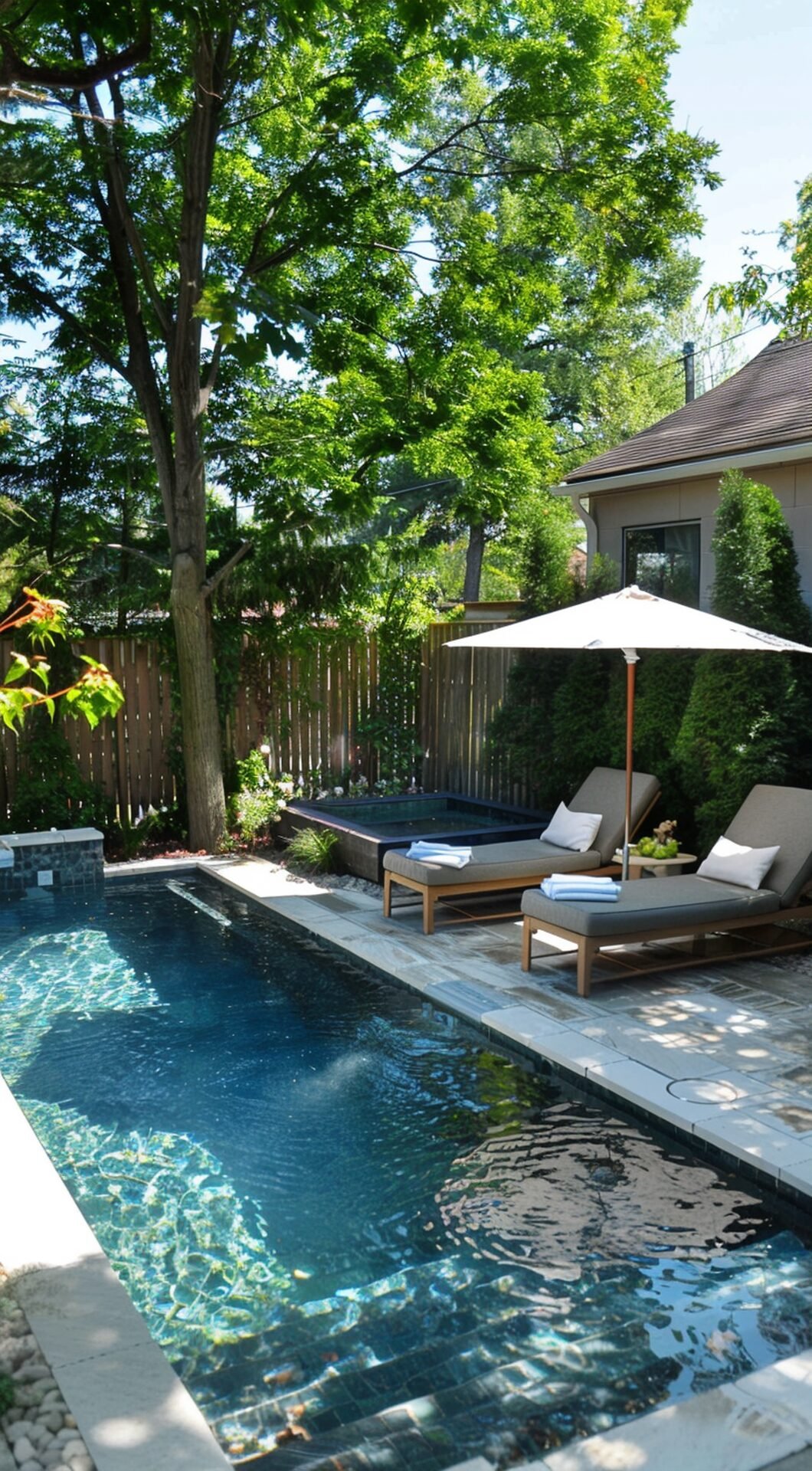
Layer landscaping rocks in warm natural tones around the perimeter and install vertical garden planters along the fence to deepen that earthy, organic character. Set a pair of chaise lounges on the stone surround for a comfortable place to rest between dips.
2. The Plunge Pool With a Built-In Sitting Ledge
Here’s a design mistake that shows up far too often: a plunge pool with no proper place to sit once you’re inside.
You step in. You shift around awkwardly. You half-crouch. The whole experience feels off.
An underwater bench running along one or both walls solves this problem immediately. It gives you a real place to settle, and it creates a shallower zone that works well for younger children and older guests.
Some homeowners configure the bench in an L-shape, creating a conversational corner right inside the pool.
Picture a warm summer evening, water at chest height, something cold in your hand.
That’s not a luxury — it’s a smart addition that costs considerably less than most people expect.
Complement the space with an in-pool stool for additional seating at the pool’s edge, and anchor the lounging area with a striped indoor/outdoor rug. Keep a couple of patio side tables nearby so drinks are always within reach.
3. The Freeform Plunge Pool With Lush Tropical Plants
Not every plunge pool needs rigid geometry and sharp lines.
A freeform shape — oval, kidney, or a loose organic curve — wrapped in dense tropical planting creates something that feels like a private lagoon.
Palms overhead. Birds of paradise along the fence. Oversized philodendrons spilling forward. A few well-placed boulders for scale and texture.
This design is fundamentally about escape. Open your back door and feel as if you’ve just arrived somewhere far better.
Curved forms also make compact yards feel larger, because organic shapes fool the eye into reading more space than hard angles allow.
If your home already has a coastal or tropical character, this pool will feel like it was planned from day one.
Anchor the perimeter with tall areca palm trees and a dense cedar vertical garden panel along the back fence. Hang outdoor globe string lights above for the kind of evening atmosphere that keeps guests lingering long after dark.
4. The Raised Concrete Plunge Pool
This one is a genuine solution for sloped or uneven yards.
Rather than excavating deep and battling drainage complications, a raised concrete plunge pool sits partly or entirely above grade. The aesthetic is clean, contemporary, almost architectural.
Clad the exterior in stacked stone, smooth render, or timber boards to harmonize with your existing deck or home exterior.
The practical bonus? Those raised walls work as informal seating. Guests perch on the rim. Children dangle their feet over the edge. You rest your glass on the ledge mid-soak.
Cost insight: if your yard slopes away from the house, a raised build can actually come in cheaper because you avoid the heaviest excavation work entirely.
Position a louvered aluminum pergola alongside the pool to create both shade and a defined outdoor room. Lay an indoor/outdoor area rug beneath the seating zone to anchor the space and introduce some color.
5. The Plunge Pool Woven Into a Deck
This is the configuration you see in design publications — and it earns that attention.
A timber or composite deck wraps around the pool until the water feels embedded in your living area. You step directly off the deck into the water. No awkward transition. No bulky coping edge.
The deck becomes your lounge, dining area, and pool surround all at once.
The key detail is a flush rim. The pool edge sits level with the deck surface, and everything reads as a single continuous plane.
Even a small backyard can feel dramatically larger with this treatment. It’s not an illusion — it genuinely transforms the proportions.
A word of caution: use slip-resistant decking material right at the water’s edge. Wet feet on smooth composite boards is a recipe for a trip to the emergency room. Don’t find out the hard way.
Furnish the deck with a pair of teak pool chaise lounges and stretch a shade sail overhead. A concrete-finish outdoor side table between the loungers keeps everything you need within arm’s reach.
6. The Cocktail Plunge Pool Fitted With Jets
This one is for anyone who wants relaxation taken to the next level.
A cocktail pool — sometimes called a “spool,” merging spa and pool — combines the compact footprint of a plunge pool with hydrotherapy jets, temperature control, and sometimes a dedicated warm zone at one end.
A refreshing dip in summer. A therapeutic soak in winter. One build, two completely different experiences.
For homeowners in regions with genuine cold winters, this may be the smartest investment on this entire list. You’ll use it throughout the year rather than wrapping it in a cover for half of it.
Most cocktail plunge pools run 10 to 12 feet in length. That slots into almost any residential yard without issue.
Add a large cantilever umbrella for consistent shade, and arrange reclining chaise lounges nearby so transitioning from the water to the sun requires zero effort. Hang outdoor string lights to extend the experience well into the evening hours.
7. The Glass-Paneled Plunge Pool
This design requires commitment.
A plunge pool featuring one or more clear acrylic panels lets you see the water from the outside. It’s theatrical, distinctive, and turns the pool itself into a piece of outdoor sculpture.
Glass-walled pools are most effective when raised or semi-raised, with the transparent face oriented toward a seating area or main garden walkway.
At night, with underwater LED lighting running inside, the visual effect is genuinely breathtaking.
Is it more expensive? Yes. Does it require engineering-grade acrylic and careful structural calculation? Absolutely.
But if your goal is a backyard that stops visitors in their tracks the moment they walk through the gate — this is exactly how you achieve it.
8. The Japanese-Inspired Deep Soaking Pool
If restraint and calm appeal to you, pay attention here.
A clean, rectangular basin. Dark stone or tile. Perhaps a single bamboo spout channeling a steady stream across the still surface.
Japanese soaking pools have been refined over centuries. They prioritize depth over surface area — allowing you to sit with water at shoulder level in a pool barely 7 feet across.
Surround it with raked pebbles, ornamental grasses, and a simple timber screen for privacy.
The result reads not as a backyard feature but as a private retreat, effortlessly transplanted from a Japanese inn.
Worth considering: dark-colored tiles absorb more solar energy. In warmer climates, that means more passive heating and less strain on your heating system.
Your energy bills notice the difference over a full season.
9. The Courtyard Plunge Pool
Have a narrow side passage or a walled courtyard sitting idle? Don’t write it off.
Some of the most impressive plunge pool installations happen in spaces homeowners had completely given up on.
A slim rectangular pool — perhaps 5 feet wide and 12 feet long — can transform a forgotten corridor between your house and the boundary fence into a peaceful private sanctuary.
Install a vertical garden on the fence. Add warm lights strung overhead. Position two loungers along the sides.
Suddenly the dead zone becomes the spot everyone gravitates toward.
This layout is especially popular in townhouses and terrace homes where a conventional pool simply isn’t an option.
Working within constraints almost always produces the most inventive results.
The Mistakes That Derail Plunge Pool Projects
Before you contact a builder, it’s worth understanding what typically goes wrong.
Because problems do arise. More reliably than most homeowners anticipate.
Mistake 1: Bypassing permits.
Many homeowners assume a plunge pool is too small to require official approval. In the vast majority of jurisdictions, any permanent in-ground water feature needs a building permit. Skip the process and you risk fines, mandatory removal, or complications when the time comes to sell.
Contact your local planning authority before any groundwork begins.
Mistake 2: Neglecting drainage.
Bodies displacing water in a plunge pool have to send that water somewhere. Without proper overflow systems and site grading, it ends up against your foundation, on your neighbor’s property, or flooding your garden beds.
Design for drainage from the very beginning.
Mistake 3: Economizing on filtration.
A smaller water volume means chemical imbalances occur rapidly. One slip and you have green, murky water within days rather than weeks.
Invest properly in a high-quality filtration and sanitation setup sized correctly for your pool. This is categorically not the place to cut corners.
Mistake 4: Forgetting about shade.
A plunge pool exposed to direct sun all afternoon turns lukewarm by midsummer. Sitting in warm water when the air temperature is already punishing is not refreshing — it defeats the purpose entirely.
Budget for a shade sail, pergola, or large umbrella. Your future self will thank you every single time you use the pool.
Narrowing Down the Right Design for Your Situation
Overwhelmed by the options? Bring it back to basics.
Work through three honest questions:
First: How much usable space do you actually have? Measure carefully — never estimate.
Second: What will you actually use the pool for most? Quick afternoon cool-downs? Weekend entertaining? Year-round therapeutic soaking? The answer shapes the design.
Third: What is the existing visual character of your home and garden? A glass-walled pool beside a stone farmhouse will look jarring and out of place. Match the aesthetic language of your property.
Answer those questions with honesty and the right design reveals itself almost automatically.
Your Backyard Is Waiting for Something Worth Noticing
You spend a significant portion of your life at home.
Yet most homeowners treat their outdoor space as an afterthought. Somewhere to park the mower and let the dog patrol.
A plunge pool changes that calculus entirely.
It creates a reason to step outside intentionally. To sit and decompress. To share your space with people you like. To actually use and appreciate the property you’ve worked hard to pay for.
You don’t need a sprawling lot. You don’t need an elite contractor. You don’t need an alarming budget.
You need a clear plan, a design that genuinely fits your space, and the resolve to stop deliberating and start moving.
Your backyard has been waiting. Give it something worth the wait.