The Best Coffee Table Ideas for Every Living Room Style (33+ Options)
Disclosure : This post may contain affiliate links or paid partnerships. I may earn compensation if you click a link or make a purchase, at no additional cost to you. See my disclosure for more info.
Open any interior design magazine and the living rooms all share one quality: they look effortlessly composed, as if every decision was made with complete confidence.
Most of the time, one piece is responsible for that impression.
The coffee table.
It occupies the center of the seating area. It anchors the furniture arrangement. It is where your eyes land the moment you walk into the room, and where every person in the room naturally reaches throughout the day.
Choose the wrong one, and a beautiful sofa looks out of place. Choose the right one, and the entire room upgrades itself around it.
This guide covers more than 33 coffee table options, organized by category, alongside essential rules for sizing and styling. Use it to make a choice you will not second-guess.
Classic Designs That Stand the Test of Time
A well-designed classic never needs to justify itself. These are the options that work across decades, across design trends, and across nearly every room configuration.
1. Solid wood rectangular table. Oak, walnut, or teak finished with clean lines and no decorative excess. It works in virtually any room, with virtually any decor. The benchmark against which all other coffee tables are measured.
2. Round marble-top table. Carrara white or veined green marble on a brass or matte black base. The curved silhouette softens rooms full of angular furniture and hard surfaces.
3. Mid-century modern table. Tapered legs, a slim profile, and restrained proportions. This style has been in continuous circulation since the 1950s. That longevity is not coincidence.
4. Oval tulip-base table. A single central pedestal, no legs to navigate around, and a rounded form that flows naturally with curved furniture arrangements.
5. Parsons-style coffee table. Uniform thickness, flush legs, and a clean boxy silhouette. Available in wood, high-gloss lacquer, or upholstered finishes depending on the application.
6. Traditional turned-leg table. For rooms with a classic sensibility—warm neutrals, linen upholstery, antique accents—a turned-leg table in a rich stain completes the picture.
Bold Tables That Make a Statement
Playing it safe is a defensible strategy. But rooms that play it entirely safe rarely leave any impression at all.
If you want your living room to feel personal and considered, you need at least one element with a genuine point of view. These tables have one.
7. Live-edge wood slab table. The raw, natural edge of the wood is preserved rather than cut to a straight line. Every piece is unique. The organic quality makes manufactured furniture look sterile by comparison.
8. Hammered brass drum table. A solid cylindrical form in hammered brass that catches and distributes warm light beautifully. It adds richness to neutral palettes without demanding attention.
9. Black concrete table. Dense, angular, and deliberately heavy in presence. Not a table for every room—but for the right room, nothing else comes close.
10. Sculptural travertine table. Irregular soft-edged silhouettes in creamy natural stone. These are furniture pieces that double as sculpture.
11. Bold lacquered color table. A high-gloss table in an unexpected color—deep navy, forest green, terracotta—carries the visual weight of a full room refresh on its own.
12. Vintage steamer trunk. A restored travel trunk or military chest positioned as a coffee table delivers character, history, and hidden storage in a single functional piece.
Space-Saving Tables With Built-In Storage
A living room is a living space. People sit in it, eat in it, work in it, leave things in it.
A coffee table that only provides a flat surface is a missed opportunity. The following options do considerably more.
13. Lift-top coffee table. The tabletop raises to a comfortable working height, revealing a deep storage compartment beneath. The practical choice for anyone who regularly works, eats, or reads on the couch.
14. Coffee table with drawers. Dedicated drawers for remotes, coasters, chargers, and the other small items that accumulate on every flat surface. Contained, out of sight, and easy to retrieve.
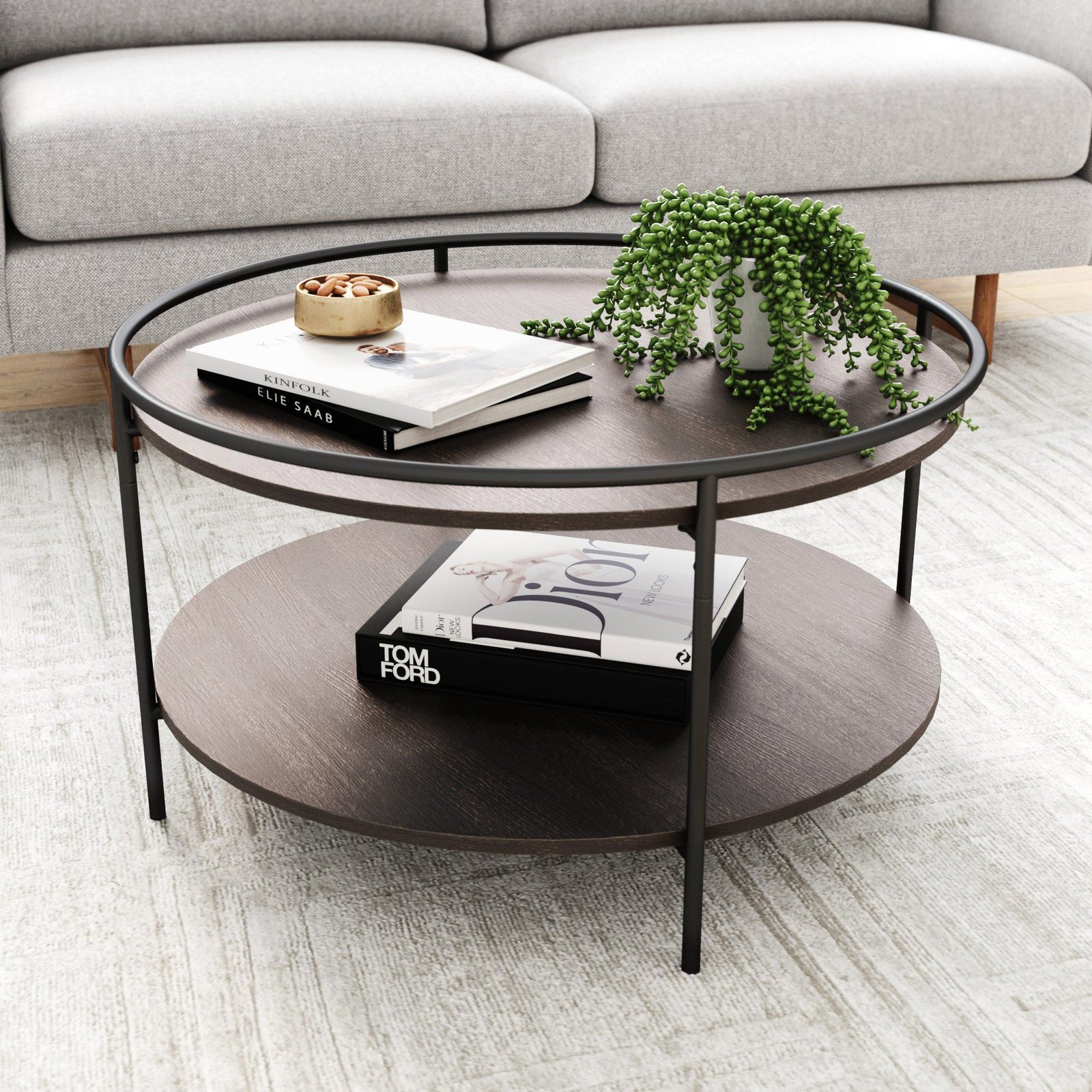
15. Open-shelf coffee table. A lower shelf provides display and storage space for books, baskets, and plants, keeping the tabletop clear and the space below purposeful.
16. Basket coffee table. A large woven basket with a sturdy flat lid that functions as a tabletop. Blankets, toys, and magazines live inside. The exterior reads as intentional decor.
17. Ottoman with a tray on top. Upholstered for comfort underfoot, storage inside, and a removable tray on top for drinks. Three distinct functions in a single piece of furniture.
18. Apothecary-style table with small drawers. A grid of small individual drawers adds structural visual interest while solving the problem of small loose items with no designated home.
The Best Coffee Tables for Smaller Rooms
A small living room is not a compromise. It is a constraint that, handled well, produces rooms that feel intentional and well-edited.
These options are scaled for tighter spaces without sacrificing presence or quality.
19. Nesting tables. Multiple tables that store compactly together and separate when you need additional surface area. Flexible, practical, and proportional to small rooms.
20. Narrow oval coffee table. A slim oval provides generous usable surface area while the rounded ends keep foot traffic moving freely and eliminate corner-to-shin contact.
21. Acrylic or lucite table. Near-transparent material that creates essentially no visual weight. The function of a coffee table with none of the visual bulk. Small rooms feel larger immediately.
22. C-shaped slide-under table. The curved base slides beneath a sofa arm or seat cushion overhang, eliminating any floor footprint while keeping a surface within easy reach.
23. A slim console used as a coffee table. A narrow console positioned in front of the sofa delivers usable surface area without claiming the visual space of a standard table.
Unique Materials That Elevate Any Space
The materials most furniture retailers offer are a small fraction of what is actually available. These options bring genuine texture, rarity, and visual interest.
24. Petrified wood. Cross-sections of fossilized ancient wood as a tabletop. Structurally stable, visually arresting, and millions of years in the making. People will touch it without being told to.
25. Terrazzo. Stone chips, glass fragments, or shell embedded in a poured smooth surface. Each piece is slightly different. The speckled pattern adds quiet movement to a room.
26. Rattan or woven cane. Lightweight, open-weave texture that reads as coastal, Scandinavian, or bohemian depending on the surrounding decor. Airy without being insubstantial.
27. Smoked glass with blackened steel. Dark glass and blackened steel together create a contemporary, editorial combination that suits monochromatic and minimalist interiors well.
28. Hand-poured resin. Cast in molds to mimic natural stone, ocean movement, or abstract art. Functional, one-of-a-kind, and reliably the first thing guests notice.
29. Ceramic or hand-plastered. Rounded, organic forms in matte natural finishes—plaster white, raw terracotta, sage. They look handmade because they are.
Setup Ideas Most People Overlook
A coffee table does not have to be a single rectangular piece in the geometric center of the seating area. These arrangements challenge that assumption effectively.
30. Two matching side tables pushed together. Combine them into one cohesive surface or separate them for independent use. The flexibility of two pieces with the visual weight of one.
31. A cluster of three small stools. Different heights, consistent material. Grouped at center for a coffee table effect, dispersed when extra seating is needed.
32. A thick butcher block slab on hairpin legs. A straightforward DIY build for less than the cost of a dinner out. It looks purposeful and custom.
33. A garden stool as a mini coffee table. Ceramic garden stools are affordable, available in dozens of finishes, and work surprisingly well alongside low sofas and accent chairs.
The Right Way to Style a Coffee Table
Choosing the right table is half the work. How you dress it is the other half.
Most people get the styling wrong not because they lack taste, but because no one ever explained the principles. These are the ones that matter.
Use a tray to create definition. A decorative tray placed on the surface functions as a visual frame. Objects within the tray look curated. Objects outside it look abandoned. The tray does not need to be large—it needs to be present.
Arrange in odd numbers. Three objects of different heights always read as more intentional than two or four. A candle, a small plant, and a stack of books. Start there.
Include something organic. A small succulent, a vase with a single cut stem, or a cluster of dried botanicals. Living or dried plant material makes a surface feel warm and finished in a way that no decorative object can replicate.
Elevate with stacked books. Two large-format books laid flat create a plinth. Place a smaller decorative object on top. The varying heights give the arrangement dimension.
Preserve empty space. White space on a coffee table is not wasted space. It is what makes the objects around it register as choices rather than accumulation.
Common Size Mistakes and How to Avoid Them
The most beautiful coffee table in any catalog will look wrong in your room if the proportions are off. These four measurements prevent the most common errors.
Height. The table surface should align with the height of the sofa cushions or sit one to two inches below. A table that rises above cushion height is both awkward to use and uncomfortable to look at.
Length. Aim for roughly two-thirds the length of the sofa. A table that exceeds this reads as overwhelming. A table that falls short looks disconnected from the furniture it is meant to serve.
Clearance. Between 14 and 18 inches of space between the table edge and the sofa is the functional range. Less than 14 creates circulation problems. More than 18 means no one can reach their drink without leaning forward.
Shape. Sectionals are best paired with round or square tables that fill the inside corner naturally. Standard sofas are typically better served by rectangular or oval options.
One final note.
Mismatching is valid design practice. The coffee table does not need to match the side tables. Combining different materials—warm wood with brushed metal, for instance—adds depth and makes the room feel layered rather than bought all at once from a single catalogue page.
Getting the Most From Any Budget
Here is something the furniture industry does not advertise.
Budget has very little to do with outcome.
A thrift store find with correct proportions, a suitable material, and considered styling will outperform a high-priced table that is wrong for the room. Every time, without exception.
The variables that determine whether a coffee table works are: the right dimensions for the space, a material that suits the lifestyle, a shape that complements the furniture, and a style that reflects the room’s character. Get those four things right and the price becomes secondary.
Your Living Room Is Worth the Upgrade
More than 33 options. The core principles of sizing. The rules of styling. The mistakes worth avoiding.
Everything needed to make an informed, confident choice is in this guide.
The only remaining variable is what you do with it.
A decision deferred is a decision to continue living with a room that does not work as well as it should. The right coffee table is not a luxury. It is the piece that makes the rest of the room make sense.
Find the one that fits your space. Style it well. And stop walking past a room you wish looked different.