27 Chair Styling Mistakes That Are Quietly Killing Your Living Room
Disclosure : This post may contain affiliate links or paid partnerships. I may earn compensation if you click a link or make a purchase, at no additional cost to you. See my disclosure for more info.
You walk back into the living room for the hundredth time.
And something still isn’t right.
You repainted. You swapped the rug. You replaced the throw pillows — twice. You even borrowed your neighbor’s art for a weekend just to see if that was it.
Still wrong.
You spend twenty minutes scrolling through design accounts online. Every single room looks effortless. Layered. Thoughtful. Like someone actually planned it.
Then you glance back at your own space.
And you think: “Why does mine look like a waiting room?”
Here’s what the design world isn’t saying out loud:
It’s not the art. Not the lighting. Not the throw blanket on the sofa.
It’s your chairs.
The ones you picked on a whim. The ones that were a good deal. The ones that technically “fit” without ever asking whether they belonged.
Chairs occupy more visual space than almost any other piece in a room. They control traffic flow, sight lines, and the overall mood of the space.
Get them wrong, and everything around them suffers for it.
Get them right? The whole room clicks into place.
These twenty-seven tips will show you exactly how to stop making the mistakes that are quietly undermining your living room — and what to do instead.
Practical. Specific. No filler.
Let’s fix this.
Proportion and Form: The Errors You Don’t See Coming
1. Measure the space before committing to any chair.
You fell for it online. It looked proportional, elegant, exactly right.
Then it showed up at your door and turned your living room into a hallway.
This catches people off guard every single time. A chair photographed in a vast showroom reads completely differently in a compact apartment. Tape the footprint on your floor first. Walk around it. Live with the outline for a day. Then buy.
2. Introduce a curved chair into a room dominated by straight edges.
Square shelves. Rectangular coffee table. Boxy sectional. Right angles stacked on right angles.
Visually, that rigidity becomes exhausting.
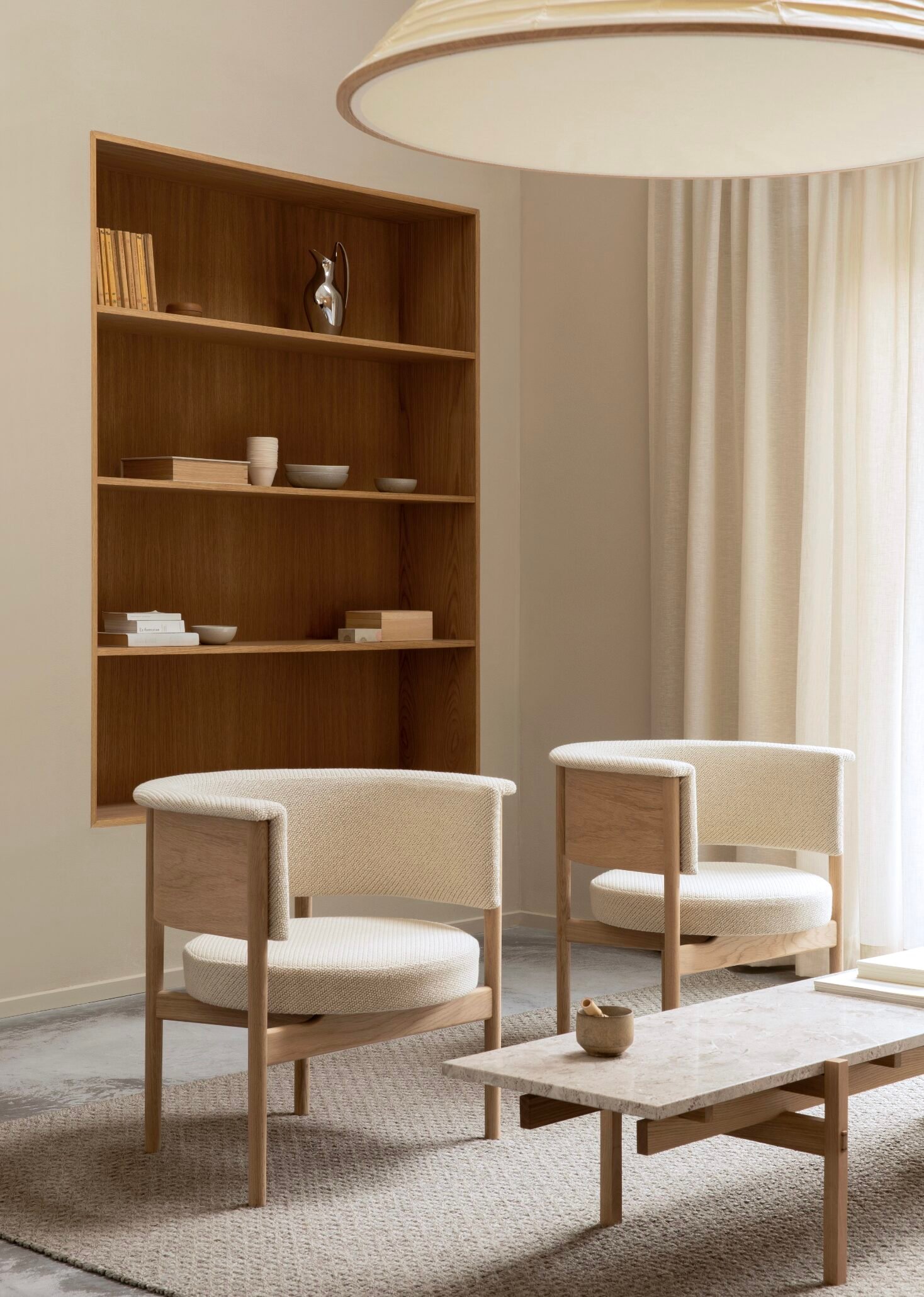
A single chair with a rounded silhouette or barrel back disrupts the pattern in the best possible way. It softens the room without any other change being required.
3. Use a low chair to trick the eye into seeing more ceiling height.
Low-profile seating creates an optical gap between the top of the furniture and the ceiling above.
That gap reads as height. In rooms with standard eight-foot ceilings, this one adjustment makes the proportions feel genuinely roomier.
4. Choose legs that expose the floor beneath the chair.
Tapered legs. Thin metal pins. Any leg style that lets the floor show through.
More visible floor creates a sense of openness. Dense skirted chairs that conceal everything underneath have the reverse effect — same footprint, but the room contracts around them.
5. Let one deliberately oversized chair anchor the room.
This doesn’t contradict the first tip. It extends it.
One intentionally large statement piece — a generous wingback or a deep-seated club chair — creates a visual anchor. The word doing real work there is “intentionally.” You chose scale. Scale didn’t choose you.
Fabric and Color: Where Good Intentions Go Wrong
6. Resist the urge to match your chairs to your sofa.
It feels safe. You buy a greige couch and greige chairs. Everything coordinates. Nothing clashes.
And nothing interests anyone either.
Visual engagement depends on contrast. A navy chair beside a warm gray sofa. A rust-colored accent seat across from a cream couch. The difference between pieces is what gives the eye something to read.
7. When color feels too bold, let texture carry the weight instead.
Not everyone is ready to commit to a terracotta accent chair. That’s a perfectly reasonable position.
But a bouclé chair in ivory? A velvet seat in warm stone? A nubby linen?
Texture generates depth at close to any neutral. Surface variation is something the eye picks up on even in a monochromatic palette.
8. Use performance fabric when your household is actually lived in.
Dogs. Children. Dinner parties. Wine that doesn’t stay in its glass.
That pale linen chair will age badly and fast.
Performance upholstery like Crypton and Sunbrella has closed the visual gap with luxury fabrics. It resists staining, cleans well, and lets you own a nice living room without treating it like a museum.
Almost no one mentions this in design coverage. It matters enormously in practice.
9. Designate one chair as the room’s focal color.
One chair. One deliberate color choice. Mustard. Deep teal. Brick red. Aubergine.
Surrounded by restraint, that single note of color becomes the first thing every visitor registers. It reads as confident and purposeful — the room of someone who makes decisions.
10. Take dark leather seriously as an option.
A cognac or deep espresso leather armchair introduces warmth and substance in a way that fabric rarely replicates.
And leather actually improves with use. Patina is a feature, not a flaw. Very few materials earn character over time. Leather is one of them.
11. Consider what the back of the chair looks like.
When a chair sits away from the wall, the back is visible from across the room.
A chair with thoughtful back detailing — exposed wood framing, carved joinery, tufted upholstery — becomes a visual element from every direction. Most buyers look only at the front. That’s the mistake.
Arrangement and Flow: The Architecture No One Explains
12. Move your chairs away from the walls immediately.
This is the most common layout error in living rooms everywhere.
Every piece pushed to the perimeter. Furniture hugging the walls like a teenager at a school dance.
Bring the chairs forward — even a few inches. The room reads as designed rather than stored. That single shift changes the feeling of the whole space.
13. Angle chairs to encourage face-to-face conversation.
Position your accent seating at roughly 30 to 45 degrees relative to the sofa.
This produces a natural conversational geometry. People orient their bodies toward one another when they talk. Your furniture arrangement should support that instinct, not work against it.
14. Create a reading corner from a single chair.
One chair. A side table. A floor lamp. A quiet corner of the room.
That’s it. That’s a reading nook.
The effect it has is disproportionate to its simplicity. It tells anyone who enters: this room has intention. Every inch was considered. Nothing is accidental.
15. Frame your fireplace with a matching pair of chairs.
Two chairs, one on each side of a fireplace, is one of interior design’s most reliable moves.
The reason it endures: symmetry. We respond to bilateral balance at a neurological level. Even an unremarkable fireplace gains presence when properly flanked.
16. Use a chair to mark the boundary between zones in open-plan rooms.
Large open-plan spaces have a definition problem. Where does one room end and another begin?
A single chair placed at the edge of the seating arrangement creates a soft perimeter. No partition wall. No rug trick. Just one chair placed with purpose.
17. Orient your best chair toward your best view.
The window with the morning light. The garden glimpse. The street that comes alive at dusk.
That spot belongs to your most comfortable chair. A great view plus a great seat converts a room from something you maintain into something you inhabit.
Upgrades That Make Any Chair Look More Expensive
18. Replace the legs.
This is probably the most underrated tip in all of furniture styling.
Budget chairs almost always ship with legs that give the game away — plastic ferrules, standard dowels, nothing distinctive.
Swap them out. Tapered walnut. Brass-capped feet. Matte black metal. The operation takes about ten minutes and rarely costs more than twenty dollars. The chair looks like it tripled in value.
19. Add a single lumbar pillow in a contrasting material.
One is the correct number. Not two. Not four. One.
A lumbar pillow that complements without matching the chair: a stripe on a solid, velvet on linen, nubby on smooth.
It adds dimension. It adds comfort. It looks intentionally styled rather than decorated.
20. Seek out chairs with visible craft details.
Nail-head trim. An exposed wooden frame. Brass hardware. Visible stitch lines.
These features communicate quality without announcement. They imply that someone was paying attention when the chair was made. That feeling transfers to the room around it.
21. Choose a chair whose shape is interesting on its own terms.
Not every chair needs to be a padded rectangle on four legs.
A sculptural shell form. A wishbone silhouette. A sinuous back curve. When the chair has a compelling profile, it functions as a piece of sculpture. The room earns visual complexity just by including it.
Practical Moves That Most People Skip Over
22. Consider a swivel base for rooms that do multiple things.
A swivel chair rotates toward whatever the room is doing right now — the conversation, the television, the window, the person who just walked in.
No furniture rearrangement. No awkward pivoting.
It’s the most adaptable seating you can put into a living room that serves multiple daily purposes.
23. Pair the chair with an ottoman.
A chair alone is a seat.
A chair with an ottoman is an invitation to stay.
The pairing transforms a functional piece into a destination. If your living room is meant to be where you actually rest and recover, this combination makes that case physically and visually.
24. Drape a throw over one arm of the chair.
The investment here is roughly three seconds.
A knit or textured throw casually draped over an arm makes the chair look warm, lived-in, and styled. It signals ease. It draws people toward it. It’s the lowest-effort upgrade on this entire list.
The Mistakes That Are Costing You Without You Knowing It
25. Only buy chairs you’d comfortably sit in for a long stretch.
That sculptural acrylic chair photographs beautifully.
It is also cold, hard, scratchy on carpet, and conspicuously empty every single evening.
If you can’t picture spending an entire phone call or a movie in it, the chair doesn’t work for a living room. Appearance without comfort is a display piece. Your living room deserves better.
26. Test the seat depth before purchasing.
Too much depth and you spend the whole time propping yourself up with pillows just to sit at a normal angle.
Too little and it feels like a bus seat, not a chair you want to return to.
Sit all the way back against the support. If your feet leave the floor, the depth is wrong for your body. This matters disproportionately for anyone under five foot eight.
27. Rotate your chairs when the seasons shift.
You don’t need to buy new furniture with every season.
But moving a heavy leather armchair out and bringing in a lighter rattan or woven piece for summer? Swapping a cushion for velvet as the temperature drops?
Your room stays current and alive. It never settles. It never stagnates. And the cost is almost nothing.
Where Do You Go From Here?
Let’s get specific about what’s actually happening here.
Your living room chairs are not background furniture. They are the pieces that set the visual tone, absorb the daily use, and hold together every other design decision in the room.
They’re also the pieces most people put the least thought into.
That changes now.
You don’t need to overhaul everything at once. You don’t need a professional. You don’t need a significant budget.
You need one change from this list. This weekend.
Then another the week after that.
Week by week, the room evolves.
And one day you’ll walk in and realize: this is the room you’ve been trying to create for years.
Except it’s real now. And it belongs to you.
Start with one chair. Start right now.