Illuminate Your Kitchen: 29 Lighting Upgrades That Transform Any Space
Disclosure : This post may contain affiliate links or paid partnerships. I may earn compensation if you click a link or make a purchase, at no additional cost to you. See my disclosure for more info.
Every morning you walk into your kitchen and flip the same switch.
The room fills with a flat, uninspired glow that makes everything look mediocre. Your countertops. Your cabinets. The backsplash you saved up for.
Here is the truth most homeowners never figure out: it is probably not the kitchen. It is the light.
Lighting is the single most underestimated variable in any home. Get it right and a modest kitchen looks like it belongs on a design blog. Get it wrong and even an expensive renovation feels flat and forgettable.
This guide covers 29 specific upgrades, organized by layer, so you can finally make your kitchen feel the way it deserves to feel every day.
The Hidden Reason Your Kitchen Never Looks Quite Right
Light shapes how you perceive every surface in your kitchen. Cabinet color. Countertop texture. Whether the whole room feels warm or clinical the moment you walk in.
Poor lighting drains energy from a space. It makes expensive finishes look cheap and turns a room you love into one you want to leave quickly.
Good lighting does the opposite. It adds warmth and definition, draws the eye to your best features, and makes the space genuinely enjoyable to be in.
The key is working in three layers: ambient for overall coverage, task for working surfaces, and accent for atmosphere and emphasis. Leave out any one layer and the room will always feel incomplete.
Ambient Lighting: Your Kitchen’s Most Important Base Layer
Ambient light is the room’s default glow. It covers the full space and sets the tone for everything built on top of it. Get this right before anything else.
1. Recessed ceiling lights with a dimmer
Recessed lights are dependable workhorses. Their real power unlocks when you pair them with a dimmer switch. Full brightness for prep work. A softer tone for dinner. One small addition that changes how the room functions all day long.
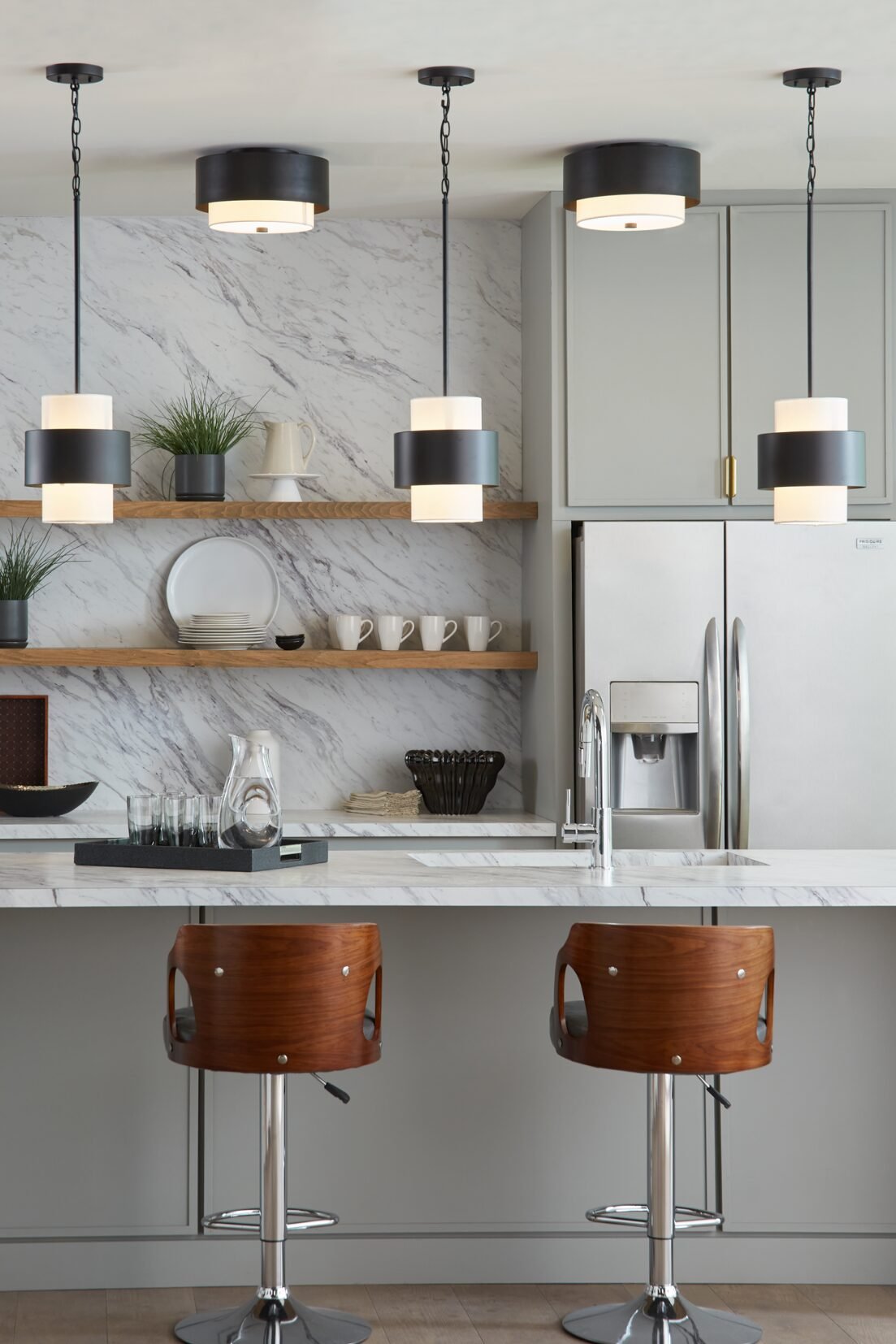
2. Flush mount with a frosted glass diffuser
When recessed cans are not an option, a flush mount with a frosted diffuser is the reliable alternative. Frosted glass scatters light evenly and eliminates the harsh shadows that clear glass creates.
Always choose frosted over clear. Clear glass shows every speck of dust and throws glare directly at eye level.
3. Semi-flush mount with a fabric shade
For a warmer, more lived-in atmosphere, a semi-flush mount with a linen or fabric shade brings softness overhead that no glass fixture can match. One of the quickest ways to make a kitchen feel less sterile and more like a home.
4. Slim LED panel lights for low ceilings
Low ceilings and chunky fixtures are a bad combination. They shrink the room visually and block light from spreading properly.
Slim LED panels mount nearly flush with the ceiling and produce a strong even light without competing for vertical space.
5. Cove lighting around the ceiling perimeter
LED strip lights concealed in a shallow ceiling ledge create one of the most elegant ambient effects possible. The light bounces upward, producing a diffused, shadow-free glow that makes every kitchen look bigger. It feels expensive. It is not.
Task Lighting: See Clearly, Work Better
Task lighting is functional first. But when chosen well it is also one of the most striking layers in a kitchen’s overall design.
6. Under-cabinet LED strips
The upgrade that delivers the most immediate visible impact in almost every kitchen.
Under-cabinet strips flood your countertops with direct light, eliminate shadows, and make your backsplash pop. Adhesive LED kits make this a one-afternoon project with no electrician required.
7. Under-cabinet puck lights
If you prefer focused pools of light rather than a continuous strip, puck lights are the right choice. Each one concentrates illumination on a specific zone for a more dramatic, directional effect.
8. Pendant lights over the island
Nothing transforms a kitchen island quite like well-chosen pendant lights.
A pair of pendants creates a visual anchor and lights up your prep area. Hang them 30 to 36 inches above the countertop.
9. Linear suspension light spanning the island
For a cleaner, more unified look, a single linear suspension fixture stretches across the full island and distributes light more evenly than individual pendants. A more architectural choice that suits contemporary kitchens beautifully.
10. Flexible track lighting
Current track systems are slim, minimal, and incredibly adaptable. Each head can be aimed independently at exactly the surface that needs it most. Perfect for kitchens with unusual layouts.
11. Swing-arm wall sconces near the range
This idea surprises people. And then it wins them over completely.
A swing-arm sconce near your cooktop delivers adjustable, direct light right where you need it and adds a layer of character to the area of the kitchen that usually gets no design attention at all.
12. Better bulbs in your range hood
Your range hood already has a built-in light. The stock bulbs are almost always weak and unflattering.
Swap them for warm, high-output LEDs and your stovetop becomes one of the best-lit surfaces in the kitchen. Takes five minutes.
Accent Lighting: The Layer That Elevates Everything Else
Accent lighting is where good kitchens become exceptional ones. It adds depth, highlights beautiful surfaces, and creates a warmth that overhead fixtures cannot produce on their own.
13. LED lights inside glass-front cabinets
Glass-front cabinets without interior lighting are only doing half their job. They display your ceramics and glassware but leave them in shadow after dark.
LED puck lights or strips installed inside transform the cabinet into a display case. The effect is immediate and unmistakably elegant.
14. Upward-facing lights on top of upper cabinets
The gap between your upper cabinets and the ceiling is often treated as dead space. It does not have to be.
LED strips placed on top of the cabinets and aimed upward create a warm indirect glow that makes the ceiling feel higher. Easy to install, easy to love.
15. Toe-kick lighting at floor level
LED strips installed in the toe-kick space beneath base cabinets cast a low ambient glow that makes the cabinetry appear to float.
It looks far more expensive than it is. And at midnight it works perfectly as a gentle light that lets you navigate the kitchen without blinding yourself.
16. LED strips behind open floating shelves
Open shelving has dominated kitchen design for years. But without lighting, those carefully styled shelves go dark after sunset.
LED strips along the back edge or underside of floating shelves give every displayed object a soft defining glow. Books, plants, ceramics all look intentionally lit.
17. Glowing translucent kickboard panels
A step beyond standard toe-kick lighting, translucent panels replace the standard base cabinet panel with a glowing surface that emits light evenly at floor level.
It is a bold, unmistakably modern effect. In contemporary kitchens it is a genuine showpiece.
18. Auto-activated lights inside deep drawers
A drawer opens. The light turns on. It is that simple.
Battery-powered, motion-activated LED strips inside deep drawers make it easy to see everything at a glance. Installation takes minutes.
Statement Fixtures: The Ones That Define Your Kitchen’s Character
Sometimes one well-chosen fixture communicates more about a kitchen’s style than everything else in the room combined.
19. A single oversized pendant
One large pendant — woven rattan, blown glass, or architectural metal — commands attention above the island or dining nook. It gives the space a focal point and an unmistakable point of view.
20. A chandelier above the eat-in area
Yes, a chandelier in the kitchen. It works.
Even a modest chandelier above a breakfast nook elevates the entire zone instantly. It signals that this is a room worth spending time in.
21. Lantern-style pendant lights
Lantern pendants bring artisanal warmth that works across farmhouse, transitional, and eclectic kitchens alike. The open cage lets light scatter in every direction while adding architectural interest overhead.
22. A layered cluster of small pendants
Instead of a neat row of matching fixtures, hang a cluster of small pendants at varying heights. It looks considered rather than random. Designers use it precisely because it feels less predictable.
Smart and Specialty Lighting: Modern Solutions Worth Your Attention
You do not need a fully automated home to benefit from smart lighting. Even one or two targeted upgrades can change how you interact with the kitchen each day.
23. Tunable smart bulbs
Color temperature affects how comfortable your kitchen feels at different times of day. Smart bulbs let you shift between warm evening tones and cooler daylight with a tap. One bulb, many moods.
24. Motion-activated lights inside pantries and cabinets
No wiring. No drilling. Battery-powered lights that take five minutes to install activate the moment you open the cabinet door. Simple, practical, and one of those upgrades you wonder why you waited for.
25. Cabinet hardware with integrated LED strips
A niche option worth knowing about. Select modern cabinet pulls come with built-in LED illumination. When lit, the hardware itself becomes part of the kitchen’s light design — subtle, distinctive, and contemporary.
26. A solar tube for genuine natural light
No artificial light fully duplicates what natural daylight does for a kitchen. If yours lacks adequate windows, a solar tube — a reflective shaft from roof to ceiling diffuser — can flood the room with real daylight without a structural renovation.
Color Temperature and Placement: Two Details That Determine Everything
The right fixture in the wrong location, or with the wrong bulb, produces the wrong result. These three principles protect every other investment you have made.
27. Keep all bulbs between 2700K and 3000K
Bulbs above 4000K produce a cold, bluish light that makes kitchens feel like hospitals. 2700K to 3000K is the range that flatters wood, stone, food, and skin alike. Use 3500K in task areas only if you need extra color accuracy for cooking.
28. Match color temperatures, vary brightness
Mixing warm and cool bulbs in the same room is one of the most common kitchen lighting mistakes. The brain registers the contrast as something being wrong even when the eye cannot pinpoint it.
Keep color temperature consistent across every fixture. Use dimmers to control intensity. Same tone, different brightness.
29. Position task lights in front of your work surface, not behind
Stand at your counter and look at your hands. If a shadow falls across your cutting board, your lighting is positioned incorrectly.
Task lights belong in front of you. Under-cabinet strips placed at the front edge of the cabinet base solve this in most kitchens instantly.
The One Mistake That Wastes Every Other Effort
There is a single mistake that defeats even the best intentions. It happens constantly.
Choosing fixtures before planning layers.
You see a beautiful pendant online and you want it. So you buy it and hang it. And then you realize it does not fix anything. The counters are still dark. The room still feels flat. The cabinet contents still disappear after dark.
Fixtures are the final step, not the first. Build the three layers — ambient, task, and accent — first. Identify what is missing. Then choose fixtures that close those specific gaps. A beautiful fixture that fills a real need is worth everything. A beautiful fixture hung in the wrong place is just decoration.
Your Kitchen Has Been Waiting for Light That Does It Justice
Think about how much time you spend in your kitchen. The morning routine. The cooking. The conversations that happen naturally around the island. The late evenings with something warm, glad the day is done.
That room deserves lighting that supports every moment in it.
You do not need to implement all 29 ideas at once. Pick the two or three that solve your most obvious problems. Under-cabinet strips if shadows are the issue. A dimmer if mood control matters. Pendants if the island needs a focal point.
Each change compounds on the last. And the total effect — once the layers work together — is a kitchen that finally looks the way you always imagined.